
Best Triathlon Swimming Goggles: How to Choose the Right Pair for Open Water

Triathlon swim goggles have quite a lot to do. In open water they need to keep a reliable seal throughout choppy conditions, contact with your body and frequent sighting. While still staying comfortable enough that you are not thinking about them halfway to the first buoy.
Fogging and poor visibility can also turn navigation into guesswork, especially when the light changes during an early morning.
A dependable way to choose goggles for triathlon is to make decisions in the right order. Start by finding a frame and gaskets that seal on your face without needing extreme strap tension (Because a “perfect” lens is useless if water is pouring in).
Once the fit is sorted, you should be choosing a lens type and tint that matches the conditions you’ll actually be racing in.
This guide explains the main goggle styles triathletes use, how to get a stable open-water fit quickly and how to pick lenses that help you see buoys and swimmers clearly.
The goal is to make goggles a quiet, reliable part of your kit rather than a race-day variable.
Quick Decision Guide
If your main problem is that the goggles are leaking or they’re painful to wear, treat that as a fit mismatch rather than a strap problem.
Many swimmers tighten the strap to stop leaks, but too much tension can put the gaskets out of shape and create gaps, particularly near the nose.

A different gasket shape, a slightly larger frame, or a better nose-bridge width usually fixes the root cause more effectively.
If you struggle with sighting or feel boxed in during crowded starts, prioritise your field of view. Goggles designed for open water often use wider lenses that make it easier to see laterally without lifting your head as high.
That can help you stay calmer in traffic and maintain a steadier body position when you check your line.
If you like a minimal feel and already know what seals on your face, low-profile racing goggles can work well in triathlons. They tend to feel “locked in” during hard efforts, but they are less forgiving if the gasket does not match your eye socket shape.
In practice, they are a great choice only when they pass a quick seal test before you ever get in the water.
If you wear glasses or contacts, aim for the simplest solution that lets you navigate safely and confidently. Many athletes do not need perfect sight to swim straight, but you do need to see buoys, landmarks, and other swimmers clearly enough to make good decisions. Whatever you choose, test it in open water well before race week so you can confirm comfort, clarity and stability.
Types Of Triathlon Goggles
Low-profile racing goggles sit close to the face and are common among strong pool swimmers who like a compact, secure feel. Because there is less bulk, some athletes find them less distracting when turning their head to breathe or when swimming hard When the seal matches your face, they can also stay stable with moderate strap tension.

The downside of low-profile designs is that comfort and peripheral vision can be limited for some face shapes. A smaller gasket concentrates pressure over a smaller area, which can lead to deep marks or headaches if you are forcing the fit. If you regularly need to adjust mid-swim, it is often a sign that a different style will be more reliable in open water.
Wide-lens or open-water goggles are built to improve awareness in unpredictable conditions. The larger lens shape typically increases peripheral vision, which can make it easier to track buoys earlier and stay relaxed when swimmers are close on either side. For athletes newer to open water, this style often feels more confidence-inspiring because you can see what is happening without repeatedly lifting your head.

Hybrid or mask-style goggles spread pressure over a larger area of the face, which many long-course athletes find more comfortable. They can be a strong option if you have sensitive eye areas or you struggle to get a seal without needing to pull the strap tight.
The trade-off is that the larger air space and frame can be warmer, so good anti-fog habits and careful handling matter.
Prescription Triathlon Swimming Goggles
Prescription options are realistic for triathlon, but they come with trade-offs. Off-the-shelf lenses are the simplest and often good enough for navigation, though they are an approximation rather than a tailored prescription.
Custom prescription lenses can provide better correction for some athletes, but they can add a fair bit of cost, so it is worth prioritising comfort, seal and open-water stability before chasing perfect optics.
Fit and Seal For Open Water
Start with a simple suction test before using the strap. Place the goggles on your face without the strap and press gently; if they hold briefly on their own, the gasket shape is like to be the right one for your eyes.
If they fall off immediately, you may still be able to make them work, but you are more likely to compensate with excessive tension.
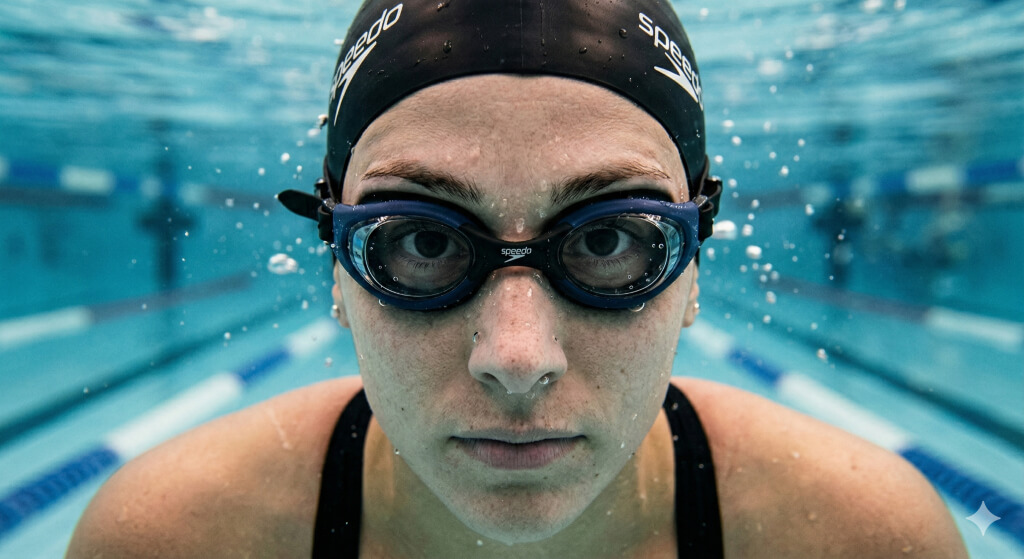
Next, pay attention to nose-bridge width because small spacing errors can cause leaks. A bridge that is too narrow can pinch and lift the inner corners of the gasket, while a bridge that is too wide can leave gaps near the nose. If your goggles include interchangeable bridges, test a couple dry, then confirm the best option in the water.
Set strap tension for stability rather than force. With split straps, many swimmers do well when one band sits higher toward the crown of their head and the other sits lower toward the base of their, which helps resist slipping when you sight or get bumped. If you feel pressure building quickly, it is often a sign the seal is being forced rather than matched.

Open-water stability is also influenced by how your cap and strap interact. Some swimmers prefer the strap under the cap for security, while others prefer it over the cap for quick adjustments. Either can work as long as the cap is not pushing the frame out of position.
Finally, test goggles the way you race, not just with easy laps. Include a few hard efforts, repeated sighting, and breathing to both sides, because those movements reveal small shifts that do not show up in calm swimming. If the seal breaks only when you sight, a small change in strap placement often solves it more cleanly than tightening.
Lenses and Visibility
It’s obvious that being able to see whilst you’re swimming matters. Open-water navigation depends on quick, confident decisions. A simple check whilst wearing your goggles is to look at a straight line, such as a door frame and move your gaze around the lens; excessive warping at the edges can make sighting feel oddly difficult. Some peripheral distortion is common, but it shouldn’t be distracting.
For outdoor racing, it is sensible to look for goggles that explicitly state UV protection in the manufacturer specifications. Not every product is labeled the same way, and you should not assume UV protection without clear information. If you do long sessions in strong sun, choosing clearly specified UV-protective lenses is a worthwhile consideration.
Clear lenses are best for very low light and indoor use, while amber or other contrast-enhancing tints often feel helpful in mixed light such as cloudy mornings or venues with alternating shade and sun. Smoke and mirrored lenses can be more comfortable in bright sun and high glare, but they can be too dark for early starts, heavy shade, or murky water where buoy visibility is already limited.
Polarized lenses often reduce surface glare, which can feel more comfortable on bright days, though it is worth testing in your usual venue to ensure you can still pick out buoys and landmarks clearly.
Best Choices For Your Race
For mass starts and contact, the best goggles are the ones that stay sealed with moderate tension and do not require mid-swim adjustments. In practice, that usually means a gasket that matches your face and a strap setup that resists slipping when you are bumped. Many athletes find that comfort and stability beat an ultra-minimal frame when the start is chaotic.
For frequent sighting, wide-lens open-water goggles are often the choice for swimmers. The extra field of view can reduce how far you need to lift or rotate your head to confirm direction, which helps many swimmers keep their rhythm. Pairing that with a tint that improves contrast in your typical conditions can make buoy spotting feel more automatic.
For sensitive eye sockets, hybrid or mask-style goggles are often the most practical choice, particularly for half and full-distance racing. A softer gasket and broader contact area can reduce pressure so you exit the water feeling fresher for the bike and run. If you consistently finish with deep marks or soreness, changing frame style is usually more effective than trying to “tough it out.”
Wrapping Things Up
The best triathlon swimming goggles are the pair that seal comfortably on your face and let you see clearly in your usual conditions. Check they fit with a quick suction test, dial in nose-bridge spacing and strap placement, and then choose a lens tint that matches the light and glare you most often race in. When you have all of that in place in open water, goggles stop being an issue, allowing you to focus on your race.